


In his book The Hero with a Thousand Faces, Joseph Campbell argues that folk tales, myths, and spiritual journeys follow a common pattern, a monomyth. The hero is called upon to separate from society and face a challenge; he [sometimes she] then undertakes a journey, often aided by supernatural forces, into another world–be it the underworld, dreamtime, or the unconscious–where the hero is tested. If the hero triumphs, then he gains a boon and can return to society, enriching it.
Campbell writes: “He [the hero] and/or the world in which he finds himself suffers from a symbolical deficiency. In fairy tales this may be as slight as the lack of a certain golden ring, whereas in apocalyptic vision the physical and spiritual life of the whole earth can be represented as fallen, or on the point of falling, into ruin.”10 Otto has known a fallen world; he has answered the call, faced the challenges, and is on the verge of gazing into the cosmic fire.
But the power in the Malibu can kill. The car glows with a celestial light and rebuffs the efforts of the government scientists to control it. When Larry the evangelist approaches the car to do an exorcism, the Bible bursts into flames. The old religions are dead. Then Miller, the shaman, enters the scene. He smiles, approaching the Malibu with gentle respect. Otto asks, “What are you doing?” And Miller answers, “I’m going for a spin.” Then he motions knowingly for Otto to accompany him. In Campbell’s study, the hero returns to society with a “life-transmuting trophy . . . bringing the runes of wisdom, the Golden Fleece, or his sleeping princess, back into the kingdom of humanity, where the boon may redound to the renewing of the community, the nation, the planet, or the ten thousand worlds.”
But not in Repo Man. Maybe the world is too far gone, maybe it’s beyond redemption and the real boon of the hero-quest is escape from a crazed and dying planet. Leila tries to hold Otto back; she says, “What about our relationship?” Otto replies, “Fuck that,” and goes to join Miller. Leila, no Penelope, says, “I’m glad I tortured you!”
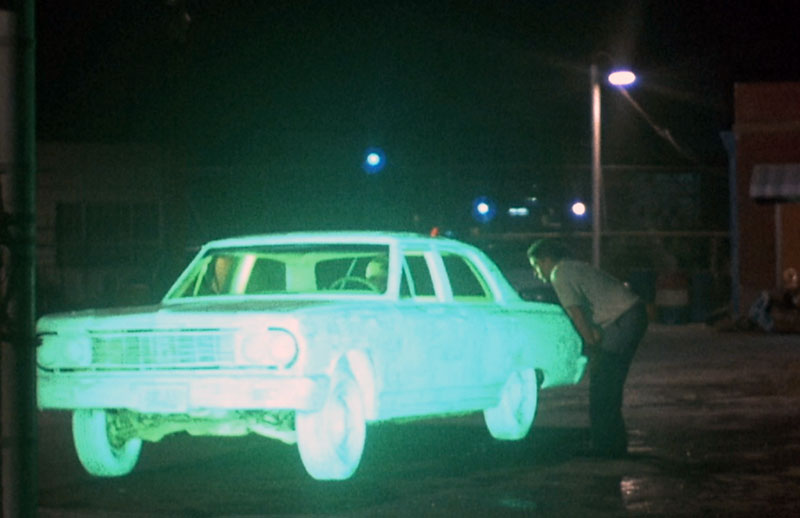
Miller Takes the Wheel
Although Miller can’t drive a car, he easily masters the cosmic forces focused in the Malibu. He’s become a cosmic repo man and he’s taking the “boon” away from the government, the scientists, and a world that obviously don’t deserve it. As they streak across the sky in the Malibu, Otto says, “Wow! This is intense.” And Miller replies, “The life of a repo man is always intense.” Then the stars blur (think warp drive on Star Trek) and our boys, our heros, are gone.
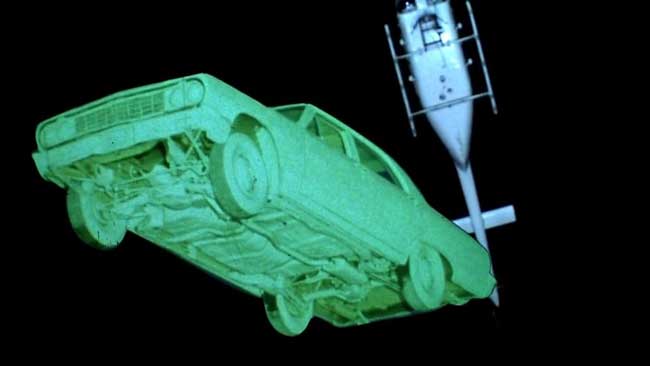
Warp Speed
Cox’s scintillating debut is a whirling interplay between grim irony and slapstick farce. Building on a skeleton of Jungian motifs, the film is as truly strange and absurd as the real world of UFO cults, military mania, Christian television, and right-wing actor presidents. Hollywood monotonously serves up rebaked comedies with the same insipid ingredients over and over again–bland pablum that passes through without offering any flavor or nutrients. The desperate brain is left to starve. In contrast, Cox’s dazzling satire is like a hit of pure oxygen to the neocortex during an L.A. smog alert.
1 C.G. Jung, Synchronicity, Princeton University Press, 1973.
2. ibid.
3. C.G. Jung, The Archetypes and the Collective Unconscious,
Princeton University Press, 1980.
4. ibid.
5. C.G. Jung, Flying Saucers: A Modern Myth of Things Seen in the Sky, Princeton University Press, 1978.
6. Marvin Harris, Cows, Pigs, Wars and Witches: The Riddles of Culture, Random House, 1978.
7. Jung, Flying Saucers.
8. Ibid.
9. ibid.
10. Joseph Campbell, The Hero with a Thousand Faces, Princeton University Press, 1973.