


When Otto, trying to be cool and debonair, attempts to pick up Leila as she runs along the street, he runs into a pile of trash with a repossessed Cadillac. When Otto and Lite, the black repo man, find wrapped presents in a car, they toss them out the window at high speed. As a box bursts, revealing bundles of cash, Lite tells Otto to read the book, Dioretix: Science of Matter Over Mind because he once found a copy in a Maserati in Beverly Hills–hinting that the book leads to personal wealth. “Dioretix” is a gibe at Dianetics and a pun on diuretics–which increase the flow of urine. Bull’s-eye.
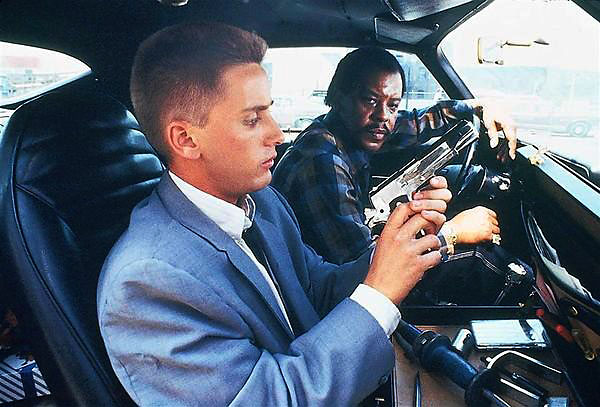
Otto and Lite — Ready to Rumble
With a strong punk soundtrack and smashing visuals, Cox drives the film forward with a high voltage montage. A scene at night opens with the drop of a clanging fire escape, a shower of multi-colored pharmaceutical capsules, and the frenzied descent of three punks fresh from a burglary. As they run away, one of the punks, humming Wagner’s The Flight of the Valkyries, stops to shake the hand of a derelict. This kind of organic detail–intensely demented verity–leaves you wondering about off screen events: what is Kevin doing in the living room of Mr. Humphries, the store manager who fired him? Who put the money in those presents? Is the humming punk a devotee of Apocalypse Now?
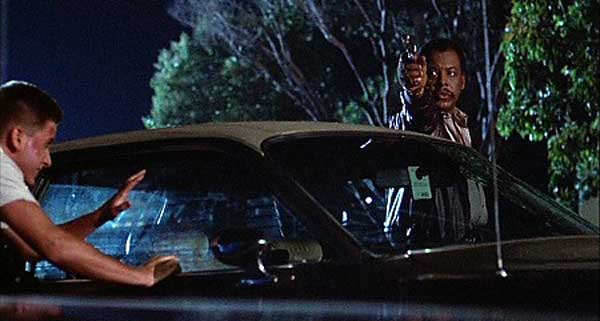
Lite Covers Otto’s Escape
Little escapes Cox’s satiric bite. Hollywood itself is lambasted. Miller sneers, “John Wayne was a fag. I installed two- way mirrors in his pad in Brentwood. He came to the door in a dress.” When Bud faces off against the government agents, parodying gangster films, he shouts, “Come on copper! I’d rather die on my feet than live on my knees.” And when Duke gets shot in the convenience store (right after proposing to Debby that they settle down like everyone else–“I want you to have my baby”), he expires with a fusillade of Hollywood cliches: “The lights are growing dim. I know a life of crime led me to this . . . I blame society. Society made me what I am.” Otto says, “Bullshit. You’re a white suburban punk.” Duke replies, “It still hurts.”
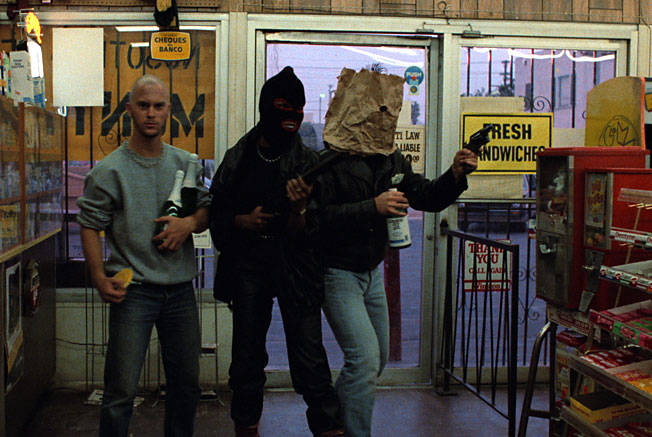
Duke, Debbie & Archie pull a heist
During the shoot-out, the camera pauses with exaggerated malevolence as each character takes a turn shooting the next; a stray bullet explodes a bottle of catsup, highlighting the Hollywood essence of the scene. Cox abuses military advertisement slogans. Scientology is zapped. Happy faces and generic brands lurk everywhere. Many of the characters get their names–Bud, Lite, Miller–from beer brands; this is further testimony to the commercial colonization of the human mind.
Miller says, “You know the way everybody’s into weirdness right now. Books at all the supermarkets about Bermuda triangles, UFOS, how the Mayans invented television–that kind of thing.” He then speculates that flying saucers are really time machines that are taking people into the past. Considering the state of the world, the punks’ nihilism is understandable, although they, too, are satirized. TV offers the crazed evangelism of Larry who howls, “God wants your money! You don’t need that car!”, and news reports of the U.S. military napalming villages in Mexico and releasing nerve gas against Nicaragua.
Cox also ridicules the science which threatens us with extinction. Jay Frank Parnell, the scientist driving the Malibu, is dying of radiation poisoning, but he tells Otto, “Radiation. Yes, indeed. You hear the most outrageous lies about it. Half- baked do-gooders telling everyone it’s bad for you. Pernicious nonsense!” He adds, “I had a lobotomy in the end.” “Isn’t that for loonies?” Otto asks. “Not at all,” Parnell insists. “Ever hear of the neutron bomb? Eyes melt, skin explodes, everybody dead. It’s so immoral it can drive you mad. That’s what happened to my friend. Now he’s had a lobotomy and he’s well again.”
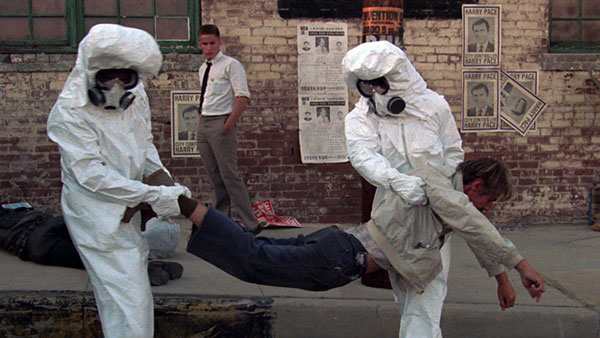
“Eyes melt, skin explodes, everybody dead.”
The schizophrenic realm of science–reason stripped of ethics–has given us nerve gas, lobotomies, and neutron bombs. The world has gone berserk, and it’s no wonder we look to the sky for saviors. The government is even worse. The agents are violent thugs who will do anything to get their hands on the Malibu. When Otto is captured, they torture him although he’s already agreed to tell them everything he knows; and they inveigle Leila, his girlfriend, to administer the shocks. When she balks, the female agent with the metal hand tells her, “No one is innocent.”
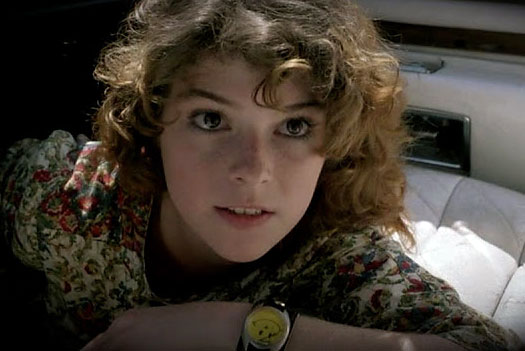
Olivia Barash plays Leila — hunting Aliens
Convinced, Leila lets Otto have it right in the electrodes. The scene is reminiscent of Stanley Milgram’s remarkable experiments on obedience; he found that an authority figure could easily persuade average citizens to punish subjects with what they believed were powerful, even life-threatening shocks. As long as the orders originate from higher up, as long as the moral responsibility is diffused, people are willing to tag along with torture, genocide, and business as usual.