


At first glance Miller, who is disheveled, spacey, and unable even to drive, seems to be a mere weirdo helping around the repo yard. No one takes him seriously. At a deeper core reality, however, Miller is a shamanic figure possessing arcane and potent knowledge. When Otto is beaten up, Miller treats him with a cold compress, dancing around him like an Indian medicine man. It is Miller who glimpses a reality beyond the mundane illusions, and who guides Otto on his “heroic journey.” In the focal scene that supplies the key to unlocking the mysteries of the film, Miller insists: “A lot of people don’t realize what’s really going on. They view life as a bunch of unconnected coincidences and things. They don’t realize there’s this lattice of coincidence that lies on top of everything. Give you an example, show you what I mean: suppose you’re thinking about a plate of shrimp. Suddenly somebody’ll say like plate or shrimp or plate of shrimp out of the blue, no explanation and there’s no point looking for one either. It’s all part of the cosmic unconscious.”

Miller, repo yard philosopher & shaman
Otto is not ready to understand and he responds, “Did you eat a lot of acid, Miller, back in the hippie days?” Clearly, Miller is describing synchronicity. And “cosmic unconscious” can be seen as a play on Jung’s idea of the collective unconscious; of which he wrote, “I have chosen the term collective because this part of the unconscious is not individual but universal; in contrast to the personal psyche, it has contents and modes of behavior that are more or less the same everywhere and in all individuals. It is, in other words, identical in all men and thus constitutes a common psychic substrate of a suprapersonal nature which is present in every one of us.”
Jung added, “The contents of the collective unconscious . . . are known as archetypes . . . universal images that have existed since the remotest times.”4 Jung believed that archetypes were partly predispositions for humans to create and respond to certain symbols–good or evil mothers, the wise old man, the trickster, the circle as a sign of wholeness–and that these recurred in dreams, fairy tales, myths, madness, and art. Although the aliens in Repo Man have arrived in flying saucers, their power is locked in the trunk of a 64 Chevy Malibu–coupled to the essence of Detroit iron, and just one of the film’s delightful absurdities.
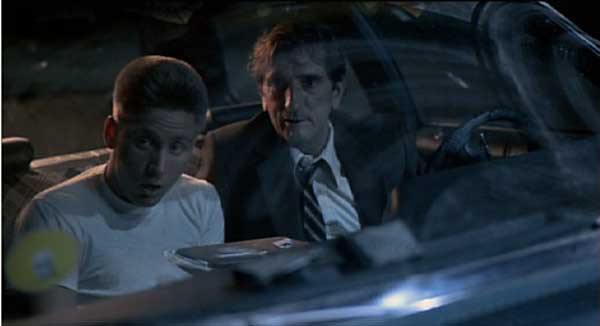
Otto and Bud on Repo Mission
Jung was fascinated by UFOs and wrote a book, Flying Saucers: A Modern Myth of Things Seen in the Sky; he was not convinced that UFOs really existed but considered them important, even if unreal, because of what they revealed about the psychological projections of numerous people worldwide. If they were a purely psychological phenomenon, Jung felt, they were indicative of a deep and cavernous need. He commented, “If it’s a rumor, then the apparition of discs must be a symbol produced by the unconscious.”5
Jung believed that modern humanity had fallen into a pit of spiritual malaise, and unfulfilled needs explained the appeal of cultism and mass movements such as Nazism. He felt that our commercialized and materialistic culture had left us bereft of guidance and enlightenment. The expectation in technological nations that flying saucers offered salvation is reminiscent of the cargo cults of New Guinea, where primitives waited for ships and airplanes piloted by their ancestors to bring a material cornucopia of food, transistor radios, and motorcycles from the gods.6 Jung wrote: “[UFOs] . . . have become a living myth. We have here a golden opportunity of seeing how a legend is formed, and how in a difficult and dark time for humanity a miraculous tale grows up of an attempted intervention by extraterrestrial ’heavenly’ powers .”7
For Jung these discs and spheres in the sky were symbols of the mandala–an archetype of order and wholeness. Terrified by a world in disintegration, people sought solace in the sky. Jung explained: “It is characteristic of our time that the archetype, in contrast to its previous manifestations, should now take the form of an object, a technological construction, in order to avoid the odiousness of mythological personification. Anything that looks technological goes down without difficulty with modern man.”8
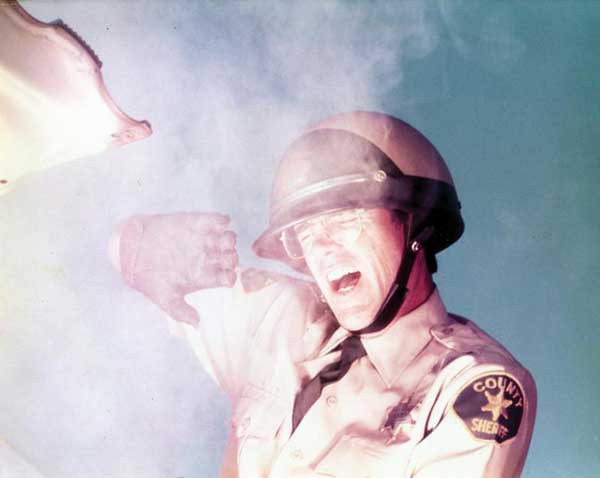
The Malibu’s Trunk Conceals Cosmic Fire
Fire and light are traditional symbols for god and transcendence. But the cosmic fire in the Malibu’s trunk is a mixed blessing; it kills a highway patrolman, a punk, and a scientist–representatives respectively of authority, nihilism, and immoral knowledge. As Jung argued: “The fiery figure is ambiguous and therefore unites the opposites. It is a uniting symbol, a totality beyond human consciousness, making whole the fragmentariness of the merely conscious man. It is a bringer of salvation and disaster at once. What it will be, for good or ill, depends on the understanding and ethical decision of the individual. The picture is a kind of message to modern man, admonishing him to meditate on the signs that appear in the heavens and to interpret them aright.”9
In Repo Man it is Miller who understands the cosmic powers and he eventually shows Otto how to tap into them. Cox’s amusingly absurd but profound narrative is propelled by a hybrid of flying saucers and synchronicity. Almost every major development in the film is linked to a “meaningful coincidence”, and Otto (a pun on auto, the repo man’s domain) loops in and out of the action in a tapestry of chance. Just by chance, Bud and Otto meet the Rodriguez brothers cruising on the bottom of a dry canal, then enter three different convenience stores where Ottos’s punk buddies are staging holdups. Unnoticed, the mysterious Malibu cuts in front of Bud and Otto on his first repossession, then passes the stalled government truck–which is searching for the Malibu–on an LA overpass.
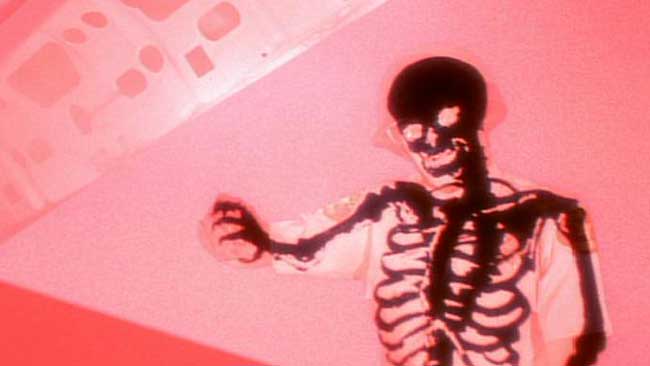
The Cosmic Fire Can Kill
Later, the car is located by the Rodriguez brothers in a gas station and stolen, and shortly thereafter re-stolen by the punk trio, fresh from a pharmaceutical heist; following that the car is again commandeered by the deranged scientist before falling into Otto’s hands–all in a chain reaction of coincidence. Kevin (Otto’s ‘normal’ friend who is fired with him at the beginning of the film) appears as an employee at the service station where the Malibu is first stolen; later he pops up at the store manager’s house, then on a gurney in the hospital–Otto covers him with a sheet to quiet him.
Air fresheners in the shape of X-mas trees, as Miller predicts, pop up frequently. Plates of shrimp, security guards, and irascible old women surface again in unlikely places in the film’s narrative stream. And there are many more improbable coincidences in Repo Man, too many to list. Everyone seems to be linked in a cosmic dance of absurdity and chance. Synchronicity runs rampant. Cox has Repo Man firing on all eight cylinders. His touch with humor is deft. Miller, for example, pontificates, “The more you drive, the less intelligent you are.” (What a pox on L.A.) Bud complains, “Ordinary fuckin’ people–I hate em!” Later he announces, “Credit is a sacred trust. You think they give a damn about bills in Russia?”